





Yesterday, 09:58 AM
(This post was last modified: Yesterday, 10:04 AM by Paul Ferguson.)
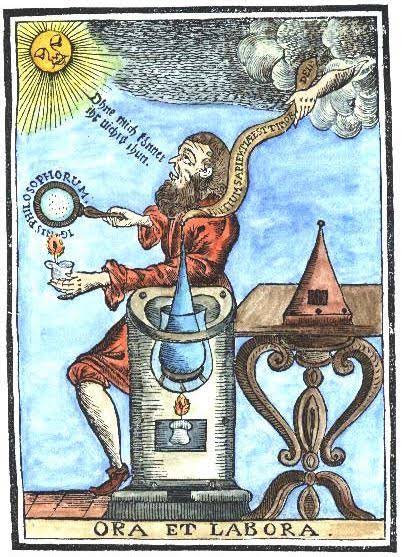
Medicinisch-chymisch- und alchemistische Oraculum is an 18th-century medical, chemical, and alchemical work published in Ulm in 1755. It is best known in modern alchemy collections for its [i]"Ora et labora" ("Pray and work") woodcut emblem. [1, 2, 3][/i]
Key Details
Published in [b]Ulm, Germany, in 1755[/b] by Johann Friedrich Gaum, Medicinisch-chymisch- und alchemistisches Oraculum appeared during a pivotal transitional period in European science. It served as a [b]practical reference dictionary[/b] designed to decode the complex shorthand used by physicians, apothecaries, early chemists, and traditional alchemists. [1, 2, 3, 4]
The Transitional Era of 1755
Key Details
- [b]Title:[/b] Medicinisch-chymisch- und alchemistische Oraculum (Medical-Chemical and Alchemical Oracle).
- [b]Publication:[/b] Ulm, Germany, 1755.
- [b]Notable Artwork:[/b] Features a woodcut illustrating the traditional alchemical motto "Ora et labora", cataloged as emblem A061 in Adam McLean's Gallery of alchemical images and indexed in The Rex Research Alchemy Archives. [1, 2, 3]
Published in [b]Ulm, Germany, in 1755[/b] by Johann Friedrich Gaum, Medicinisch-chymisch- und alchemistisches Oraculum appeared during a pivotal transitional period in European science. It served as a [b]practical reference dictionary[/b] designed to decode the complex shorthand used by physicians, apothecaries, early chemists, and traditional alchemists. [1, 2, 3, 4]
The Transitional Era of 1755
- [b]Alchemy Meets Early Chemistry:[/b] In the mid-18th century, the boundary between mystical alchemy (alchemia) and empirical chemistry (chymia) was still fluid. The book’s title explicitly bridges these overlapping worlds—medicine, chemistry, and alchemy—as practitioners still relied on shared laboratory techniques and materials. [1]
- [b]Standardizing Apothecary Shorthand:[/b] Before modern chemical formulas were invented, doctors and pharmacists wrote prescriptions using centuries-old planetary glyphs, geometric signs, and Latin abbreviations. The Oraculum gathered [b]1,829 symbols across 34 full-page engraved plates[/b] with Latin and German translations to prevent dangerous misreadings in medical and laboratory work. [1, 2]
- [b]Enlightenment Encyclopedism:[/b] The mid-1700s saw a massive European push to catalog and systematize human knowledge, exemplified by projects like Diderot’s Encyclopédie. The Oraculum applied this Enlightenment urge for order to the secretive, often chaotic visual language of older Hermetic texts, preserved in digital collections like the University of Freiburg Digital Library. [1]
- [b]Ulm as a Print Center:[/b] As a prosperous Free Imperial City in southern Germany, Ulm had a strong printing and book-trade tradition that catered to scholars, physicians, and esoteric collectors across German-speaking Europe.
- [b]The Attached Manuscript:[/b] Alongside the symbol dictionary, the 1755 edition included a purportedly rare alchemical treatise attributed to an anonymous "Reichs***" (often paired in later reprints with Geheimniss aller Geheimnisse or Clavis Sapientiae). [1, 2]
- [b]Enduring Demand:[/b] Because alchemical and pharmaceutical texts remained in circulation well into the late 18th century, the book was reprinted in Ulm by the Stettin publishing house in [b]1772[/b] and [b]1783[/b], as documented in records from the Bavarian State Library. [1, 2]