1-20 21-40 41-60 61-80 81-100 101-120 121-140 141-160 161-180 181-200 201-220 221-240 241-260 261-280 281-300 301-320
 A041. Figure from an 18th century manuscript entitled Bibliotheque des sages. |
 A042. Engraving of hermaphrodite from an 18th century version of the Rosarium philosophorum. |
 A043. Engraving from Baro Urbigerus, Besondere chymische Schrifften, Hamburg, 1705. |
 A044. Engraving from Baro Urbigerus, Besondere chymische Schrifften, Hamburg, 1705. |
 A045. Tree of dark and light from Valentine Weigel Studium Universale, 1695. |
 A046. Illustration from a manuscript in the British Library, MS. Sloane 3667, a 17th century copy of George Ripley Marrow of Alchemy. |
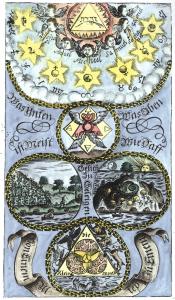 A047. Frontispiece to Hermetis Trismegisti Erkäntnüss der natur, Hamburg, 1706. |
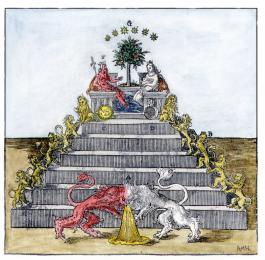 A048. Pyramid of lions, from Andreas Libavius, Alchymia, Frankfurt, 1606. |
 A049. Frontispiece from Johann Gottfried Kiessling, Relatio practica Leipzig, 1752. |
 A050. Engraving from Musaeum hermeticum, Frankfurt, 1625. |
 A051. Engraving from J.D. Mylius Philosophia reformata, Frankfurt, 1622. |
 A052. Frontispiece from Adolph Christoph Bentz, Philosophische Schau-Bühne Nurnberg, 1706. |
 A053. Frontispiece Johann Georg Schmid, Der von Mose u. denen Propheten übel urtheilende Alchymist Chemnitz, 1706. This engraving was re-used as the frontispiece to Leonhard von Altenburg, Delarvatio tincturæ philosophorum, 1769. |
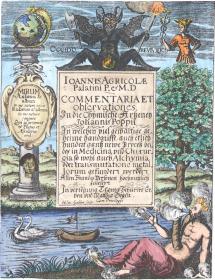 A054. Frontispiece engraving from Joannis Agricola Commentariorum, Notarum, Observationum & Animadversionum in Johannis Poppii chymische Medicin, Leipsig, 1638. |
 A055. Engraving from J.D. Mylius Philosophia reformata, Frankfurt, 1622. |
 A056. Engraving from Giovanni Lacinio, Pretiosa margarita..., Leipsig, 1714. |
 A057. Image of Phanes emerging from the world egg. Redrawn from a sculpured relief by Adam McLean. |
 A058. Redrawn from the frontispiece engraving to Denis Zachaire Die Natürliche Philosophia, 1724. |
 A059. Engraving from J. A. Siebmacher, Das güldene Vleiss, Nurnberg, 1737. |
 A060. Woodcut from Francesco Petrarcha, Das Glückbuch Beydes des Guten und Bösen, Augsburg, 1539. |